
Evolutionary Applications · 2017 · published online on October 27, 2016
Ancestry and adaptive evolution of anadromous, resident, and adfluvial rainbow trout (Oncorhynchus mykiss) in the San Francisco bay area: application of adaptive genomic variation to conservation in a highly impacted landscape
Around San Francisco Bay, the authors compare the ancestry and adaptive variation of rainbow trout populations living on either side of migration barriers. The results relate ecological context, population history and migratory traits, with implications for habitat restoration.
- The question
- How are barriers and new habitats associated with genomic differences between migratory and resident populations?
- The approach
- Comparisons of genetic structure, ancestry and variants associated with migratory traits across several watersheds.
- What the article brings
- Adaptive differences accompany the contexts above and below dams; the populations keep a native coastal ancestry.
- The limits
- The conclusions apply to the populations studied around San Francisco Bay; they do not prove the effect of each structure elsewhere.
Figures from the article
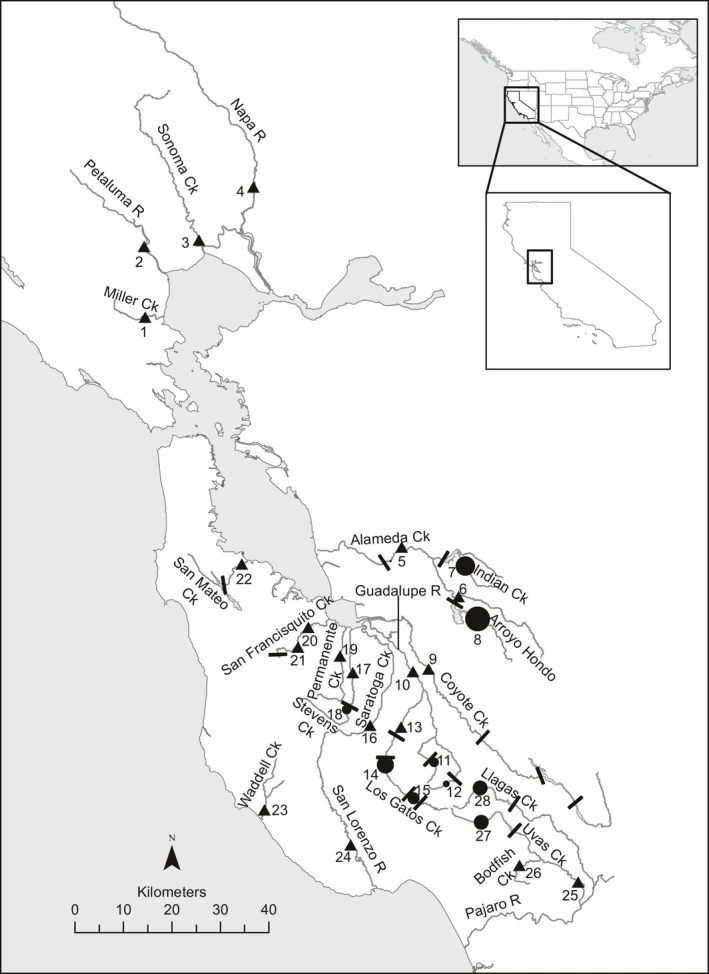 Figure (opens in a new tab)
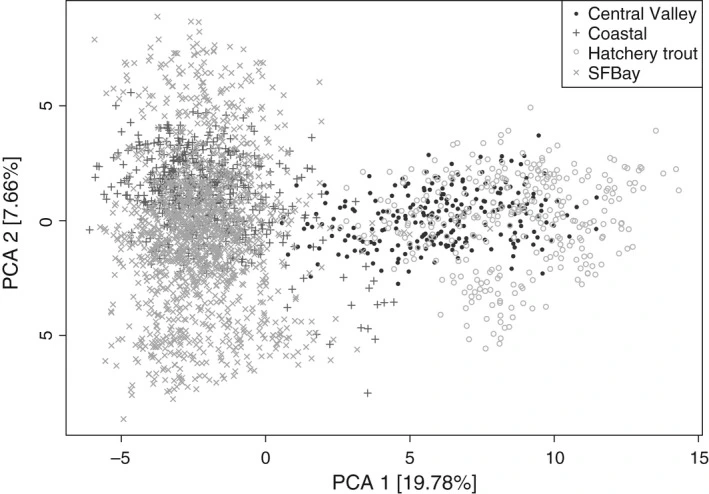 Figure (opens in a new tab)
Let’s discuss your project
Your question. Our next starting point.
A project in biodiversity, genomics or bioinformatics? Describe your needs to receive a proposal, or book a first conversation with our scientific team.
Or write to us: info@ldgenx.fr