Identifying genes for resistance to viral nervous necrosis in sea bass
Whole-genome sequencing of nearly 400 sea bass allowed fine mapping of the viral nervous necrosis (VNN) resistance phenotype in European sea bass (Dicentrarchus labrax).
Combining high-throughput sequencing data with medium-density genotyping data (~57K SNP markers) and phenotypic data revealed a strong association between a quantitative trait locus (QTL) on linkage group 12 (LG12) and sea bass survival when facing VNN infection (Figure 1, Delpuech et al. 2022 (opens in a new tab)).
From the sea bass genome annotation, openly available in public databases, we identified two genes of interest, ZDHHC14 and IFI6. IFI6, which encodes an interferon-induced protein, stands out as a strong candidate gene for VNN resistance.
Hatcheries can now use this knowledge to improve the genomic selection of their lines and develop more resistant sea bass.
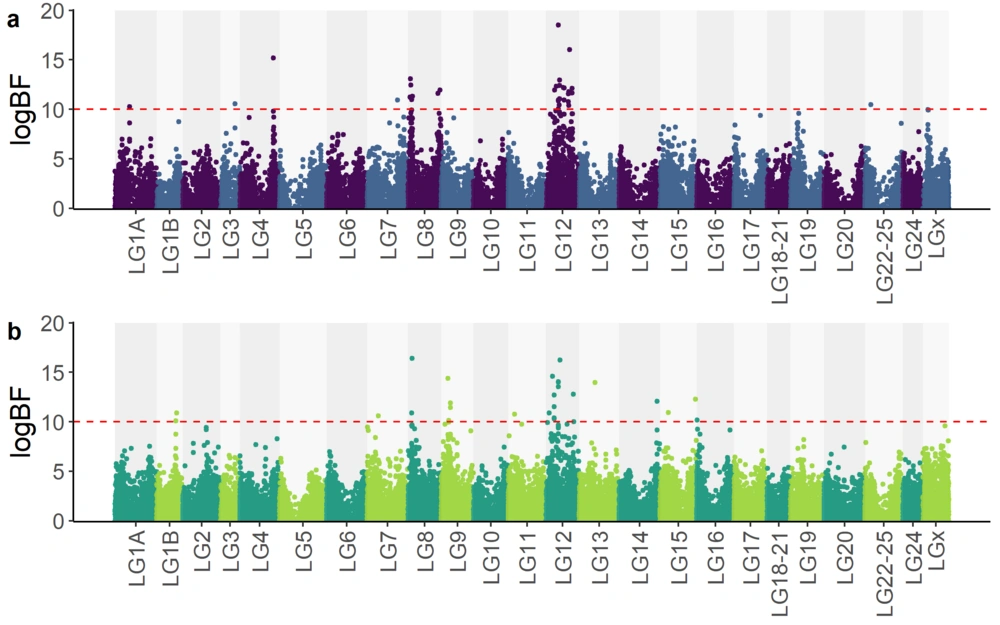 Figure (opens in a new tab)
Studying genetic values to select traits of interest
Genomic selection uses markers distributed across the genome to estimate breeding values. In aquaculture, it can improve the accuracy of predictions for resistance to some diseases compared with a pedigree-only approach. Gains nevertheless depend on the trait, reference population and breeding programme (Griot et al. 2021 (opens in a new tab)).
In a reference article on genomic prediction, Aliakbari et al. (2020) (opens in a new tab) showed similar genomic prediction using either (i) a training set of animals from genetically related lines or (ii) a training set from the target population. Combining related data with data from the target population can improve accuracy for some traits (Figure 3).
These quantitative genetics results improve the design of reference populations, especially for starting genomic selection in populations with few historical samples.
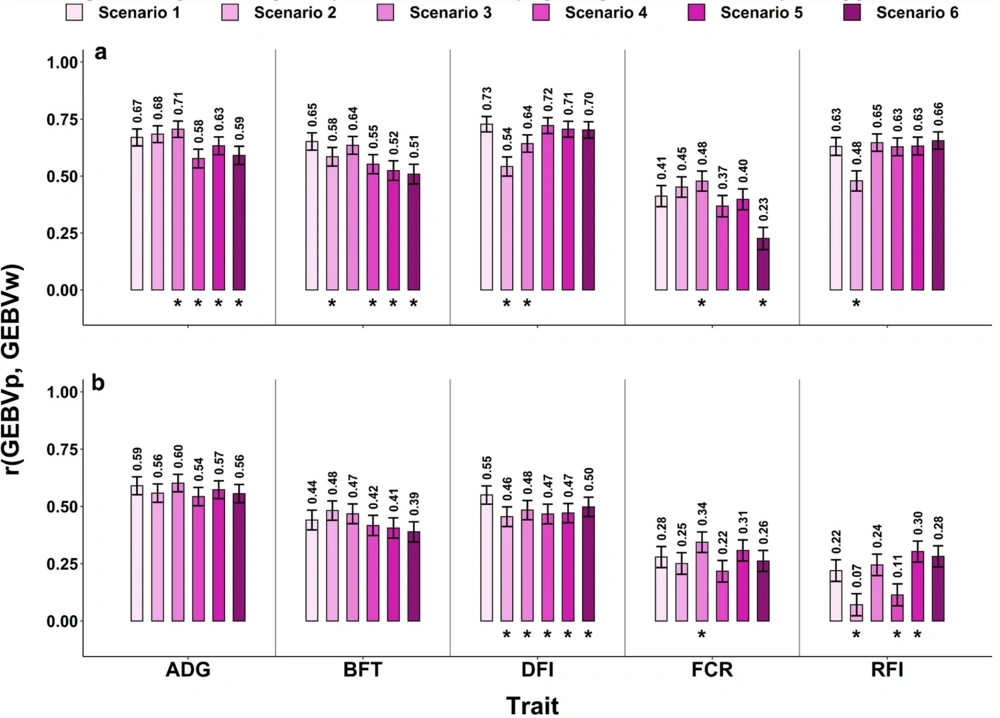 Figure (opens in a new tab)