
Environmental DNA
Reading fish DNA in turbid water.
A pilot project in the Gironde comparing water filtration methods in turbid estuaries.
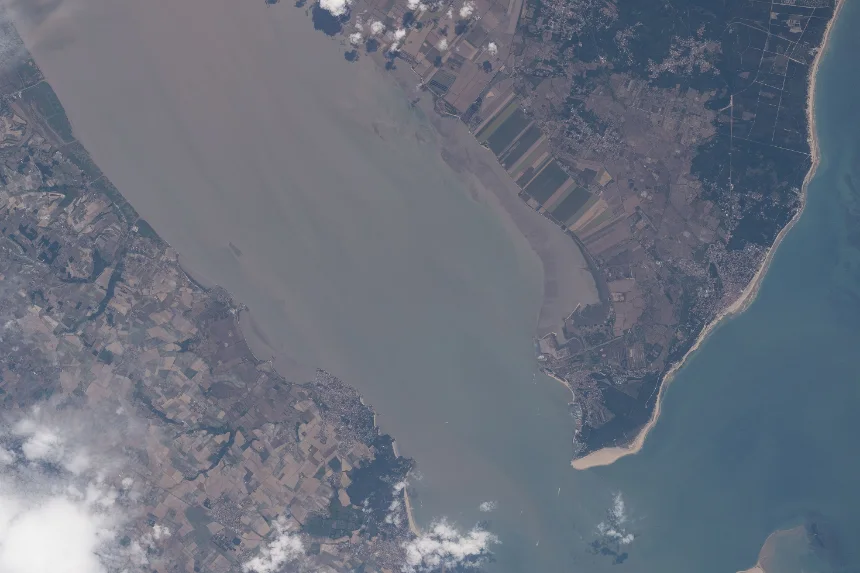
In brief
- Client
- Thibault Dindart
- Project
- ADNe Estuaire, pilot project
- Sites
- Bègles, Cadillac and Le Verdon (Gironde, France)
- Turbidity
- From 14 to more than 800 NTU
- Samples
- 43, analysed in duplicate
- Approach
- eDNA metabarcoding, fish 12S marker
- Period
- October sampling campaign
The context
In estuaries, water loaded with particles makes environmental DNA harder: filters clog quickly and particles can interfere with the analyses. This pilot project aimed to optimise eDNA protocols in turbid water.
The question
Which devices and filter sizes suit which turbidity, and which fish can be detected?
The approach
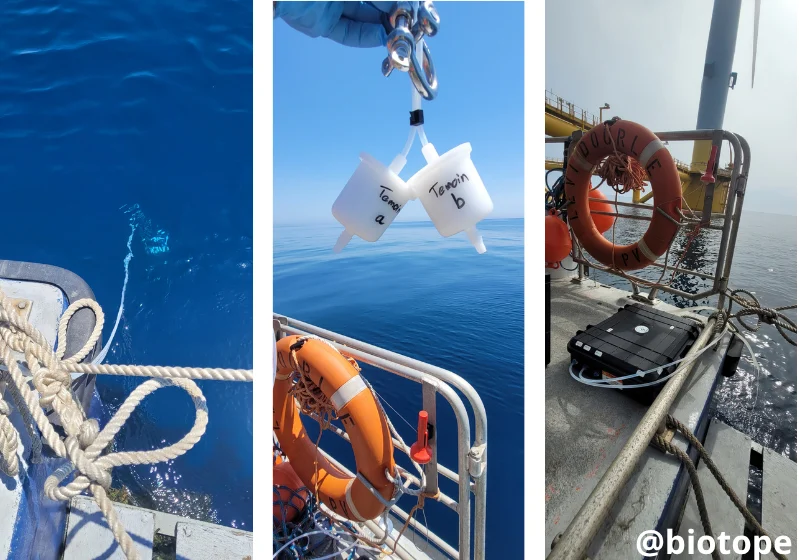
During an October campaign, water from three sites with contrasting turbidity was filtered with two systems: a triple pump with Waterra capsules (0.45, 1.2 and 5 µm pores) and a high-flow Stick Pump (20 µm filter), from 2 to 30 litres depending on clogging. The 43 samples were analysed by metabarcoding on the fish 12S marker (Teleo, Illumina short reads), in duplicate; 12 of them were also sequenced as long fragments (Oxford Nanopore).
What we learn
Detected richness is lowest at Bègles (740 to 800 NTU) and highest at Le Verdon (14 NTU). Reanalysis of the short reads identifies 26 taxa across sites and campaigns. The 5 µm filters concentrate the strongest signals, while finer filters produce a more diffuse but more diverse signal. The project recommends repeated sampling and comparison of bioinformatic tools; these observations alone do not isolate the effect of turbidity.
Species detected per site
Species richness per site, all visits combined, from short reads (table 5 of the report), from the most turbid site to the clearest: Bègles, Cadillac, Le Verdon.
From the field to species
- 3sites, from 14 to more than 800 NTU
- 43samples filtered, extracted and analysed in duplicate
- 36,730,010raw short-read sequences
- 12samples also sequenced as long fragments (full 12S)
- 26taxa identified by short reads across all sites
What the analyses show
- Bègles, the most turbid site (740 to 800 NTU), has the lowest richness: six taxa in the short-read results, pooled across campaigns (report table 5).
- Le Verdon, in clear water (14 NTU): the highest richness, with coastal marine, intertidal and freshwater species.
- Between two visits to the same site, lower turbidity accompanies a stronger sea bass signal. This association must be interpreted alongside other biological and technical factors affecting detection.
- The 5 µm filters concentrate the strongest signals; the 0.45 and 1.2 µm filters capture a more diffuse but more diverse signal.
- Short and long reads overlap: 12 shared species, 86% of the long-fragment taxa, which add two more, the goldsinny wrasse and the ruffe.
- Reanalysed with a second bioinformatic tool, the short reads yield 26 taxa, against 2 species in the first analysis: cross-checking analysis tools is one of the recommendations.
The report’s figures
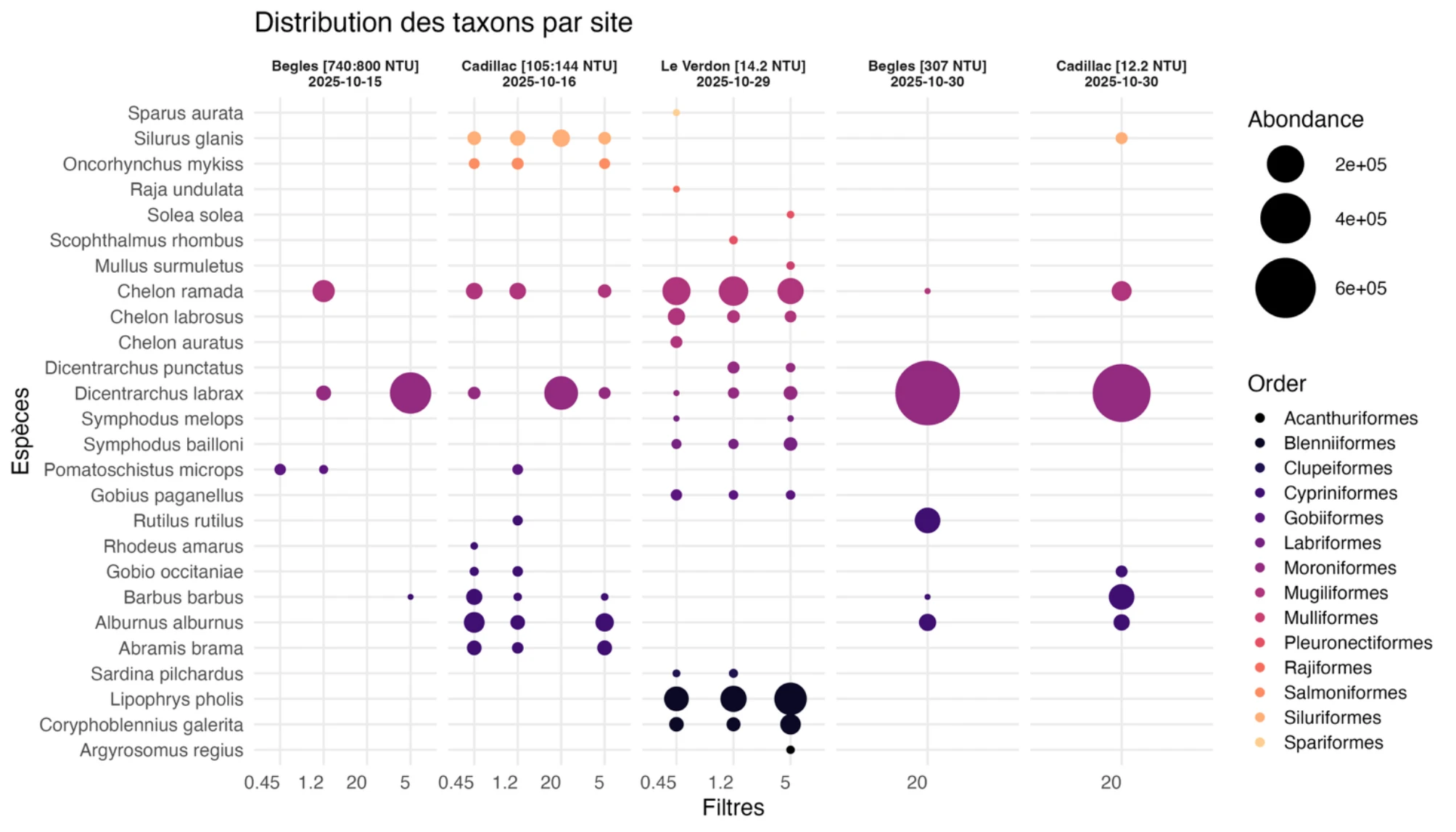 Figure (opens in a new tab)
Going further
Repeating the sampling over time at each site and combining markers of different lengths: these are the two avenues chosen to consolidate the protocol, before any public release of the occurrences.
Who did what
- Commissioner named in the report: Thibault Dindart.
- Report: Maeva Leitwein and Emilie Delpuech (LDgenX).
- DNA extraction, long-fragment sequencing (MinION) and bioinformatic analyses: LDgenX.
- Amplification and short-read sequencing: PGTB platform (Bordeaux), on an Illumina MiSeq i100.
The related service
Environmental DNA
Traces of life become a source of knowledge.
Explore this serviceThe other studies
Let’s discuss your project
Your question. Our next starting point.
A project in biodiversity, genomics or bioinformatics? Describe your needs to receive a proposal, or book a first conversation with our scientific team.
Or write to us: info@ldgenx.fr