
Population genomics
What genetic future for the Pyrenean brown bear?
A demo-genetic study of the brown bear population for the Pays de l’Ours – ADET association.
In brief
- Client
- Pays de l’Ours – ADET association
- Scientific partner
- UMR BIOGECO (INRAE, University of Bordeaux)
- Species
- Brown bear, Ursus arctos
- Data
- Population monitoring, 1975 to 2024
- Approach
- Demo-genetic modelling, projections to 2050
- Year
- 2025
The context
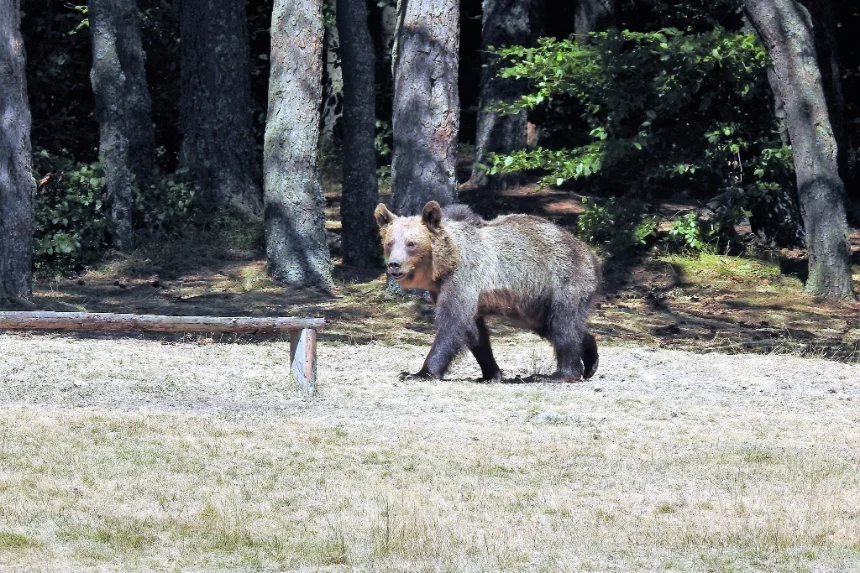
Close to extinction in the Pyrenees in the mid-1990s, the brown bear population was reinforced from 1996 with bears released from Slovenia. It was estimated at 104 individuals in 2024. Descended from a small number of founders, it remains genetically fragile: its inbreeding has been rising since the early 2000s, even as its numbers grow.
The question
What is the genetic status of the population, and which additions of bears would limit inbreeding by 2050?
The approach
A synthesis of the population monitoring data: a pedigree built from thirteen microsatellite markers, on hair and scats, from 1975 to 2024. After estimating the demographic parameters, the population is simulated from 2024 to 2050: from 0 to 200 bears introduced between 2030 and 2040, with 0 to 100% males, giving 2,475 simulated genealogies.
What we learn
Without new bears, inbreeding keeps rising until 2050. A moderate but structured reinforcement is the most effective measure: 30 bears introduced over ten years, about 70% of them females, slow the rise in inbreeding and increase the effective size of the population. Keeping the two population cores connected and coordinating management between France, Spain and Andorra complete these measures.
Time between two litters
Share of the females’ reproductions by the number of years since their last litter, from the monitoring data up to 2024 (figure 3 of the report); 1.86 years on average. “0 years”: litters with several fathers, counted as two reproductions.
From monitoring data to projections
- 1975-2024years of population monitoring analysed
- 13microsatellite markers to identify each bear and build the pedigree
- 104bears estimated in 2024, within an interval of 97 to 123
- 2,475genealogies simulated to 2050
- 0 to 200bears introduced across the scenarios, with 0 to 100% males
What the simulations show
- Without intervention, genetic erosion continues slowly but steadily: mean inbreeding keeps rising until 2050.
- In the model, numbers reach the set carrying capacity around 2035, with more than 400 bears.
- The more bears are introduced, the more the effective size and genetic diversity increase: allelic richness rises from 5.6 to more than 7 alleles per locus.
- For the same number of bears, mostly female introductions can double the genetic effective size. Inbreeding ranges from 0.40, with few and mostly male introductions, to 0.14 with many and mostly female ones.
- The recommended scenario, 30 bears over ten years with about 70% females, slows the rise in inbreeding compared with no introductions.
The report’s figures
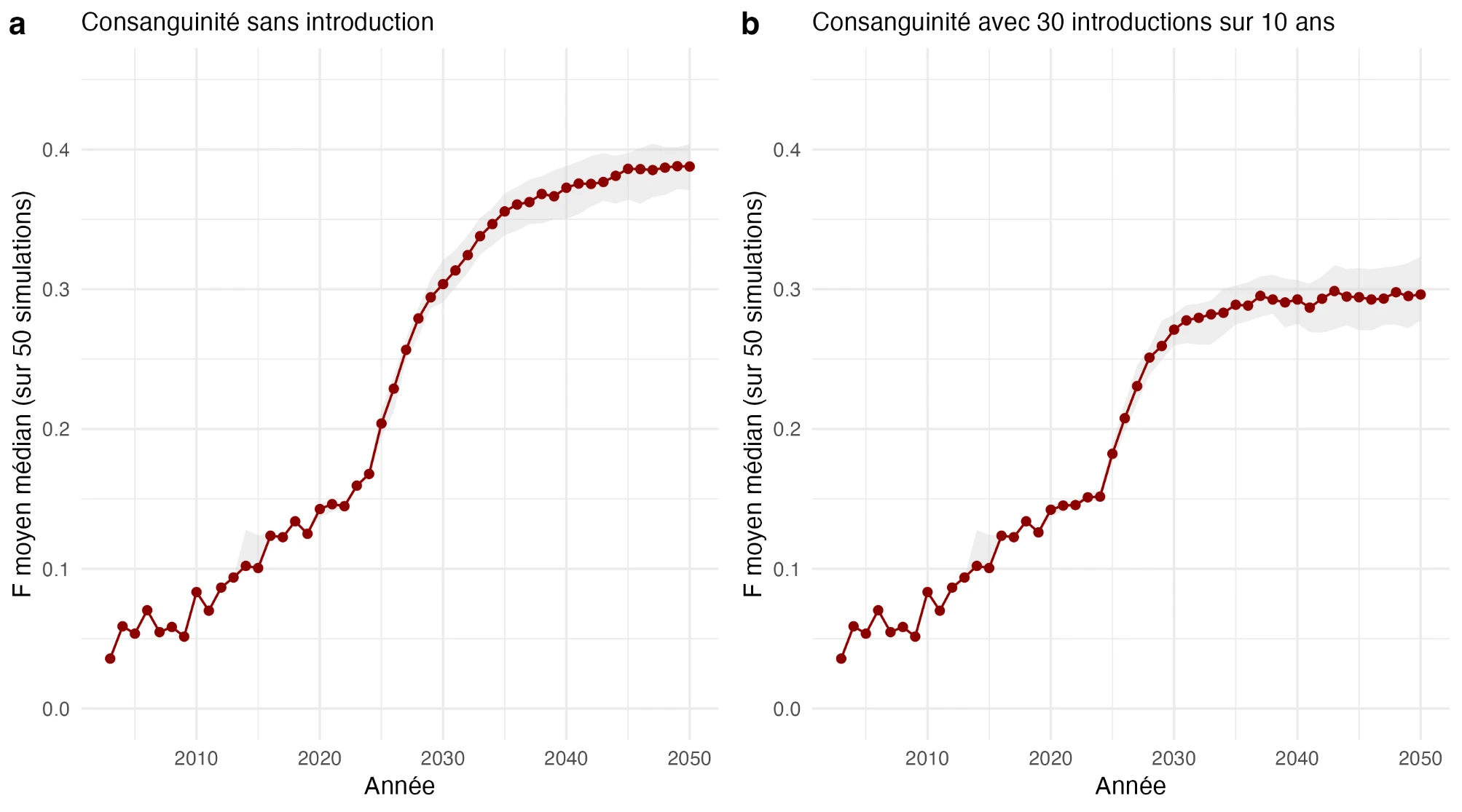 Figure (opens in a new tab)
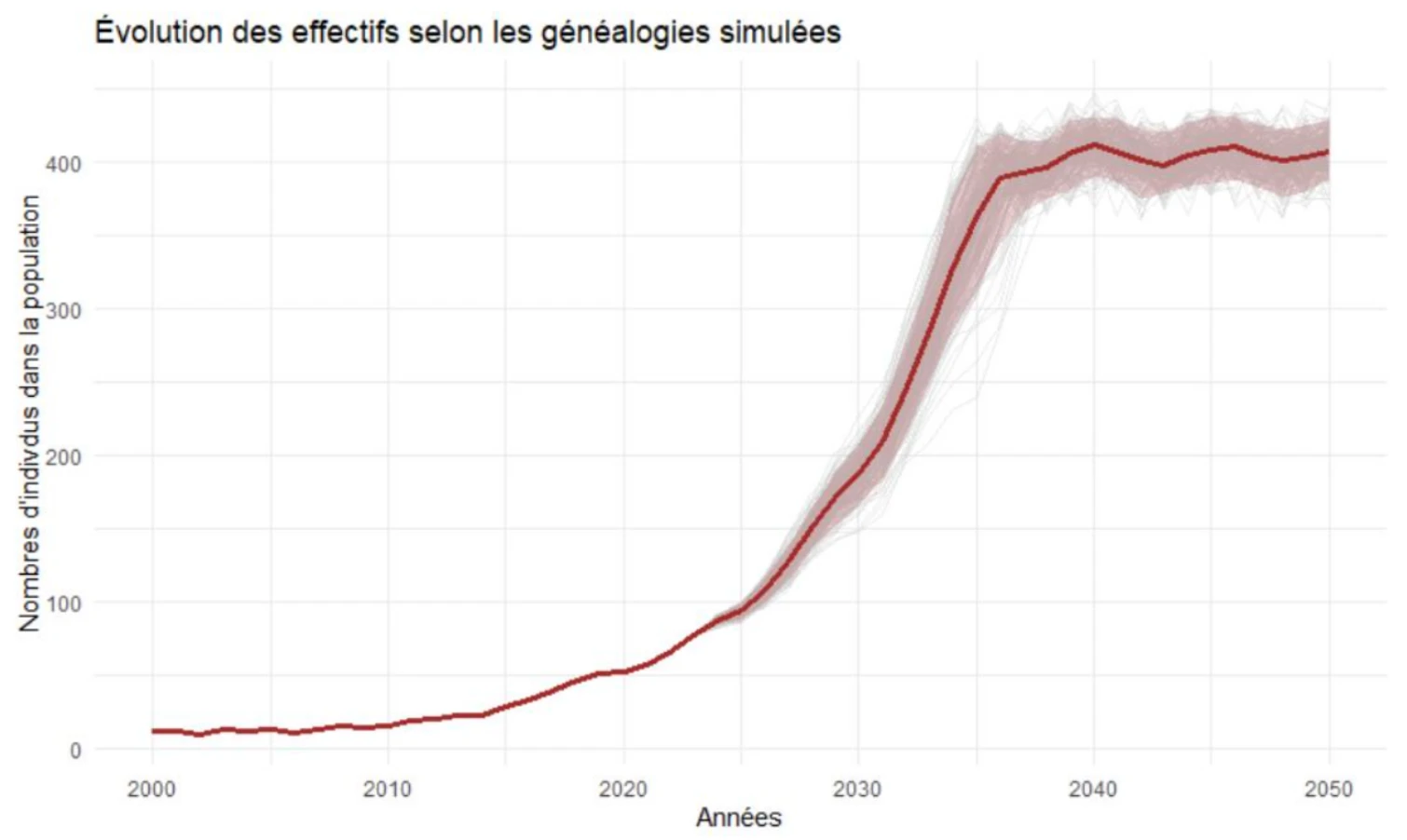 Figure (opens in a new tab)
Going further
The projections should be updated with new monitoring data. LDgenX offers to share and co-develop its simulation models with the French Biodiversity Agency (OFB), to refine the management strategies for the population.
Who did what
- Commissioned by: Alain Reynes, Pays de l’Ours – ADET association.
- Report: Maeva Leitwein and Emilie Delpuech (LDgenX). Scientific coordination: Maeva Leitwein.
- Modelling tools and statistics: Emilie Delpuech and Virgil Fivet (UMR BIOGECO), as part of the internship of Anouk Glazmann d’Hont, a second-year Master’s (M2) student at the École pratique des hautes études (EPHE), recruited for the project.
- Scientific partner: UMR BIOGECO (INRAE, University of Bordeaux).
- Monitoring data: the Brown Bear Network, led by the French Biodiversity Agency (OFB) with the Spanish and Andorran services.
The related service
Population genomics
Understanding diversity, connectivity and adaptation.
Explore this serviceThe other studies


Let’s discuss your project
Your question. Our next starting point.
A project in biodiversity, genomics or bioinformatics? Describe your needs to receive a proposal, or book a first conversation with our scientific team.
Or write to us: info@ldgenx.fr